

The Most Famous Magician You've Never Heard Of: The Extraordinary Jean Eugène Robert-Houdin
- Chris Wheel

- Feb 10
- 6 min read
Updated: Apr 12

When you hear the name Houdini, you think of the greatest magician who ever lived. But
here's the secret: Houdini himself worshipped another magician so completely that he took his stage name from him. That magician was Jean Eugène Robert-Houdin, the "Father of Modern Magic," a man who influenced not just magic but espionage, engineering, and entertainment itself.
Christopher Nolan's "The Prestige" doesn't just reference Robert-Houdin; the entire film is steeped in his legacy. The movie's setting in the golden age of stage magic, its emphasis on elegance and sophistication over crude showmanship, and its exploration of how magicians became gentlemen performers rather than street hustlers, all of this comes directly from Robert-Houdin's revolution of the art form.

From Watchmaker to Wizard
Born in 1805 in Blois, France, Jean Eugène Robert was training to be a watchmaker when fate intervened. He ordered a book on clockmaking but received a book on magic by mistake. Captivated, he devoured it and began combining his mechanical genius with theatrical performance. When he married, he added his wife's surname, Houdin, to his own, becoming Robert-Houdin.
Unlike the mystics and charlatans who dominated magic in the 1840s, Robert-Houdin performed in elegant evening wear. He was the first magician to wear a tailcoat instead of a wizard's robe, transforming magic from occult ritual into sophisticated entertainment. This single change revolutionized how audiences perceived magic and magicians.
The Illusions That Changed Everything
Robert-Houdin's performances were masterpieces of misdirection and mechanical innovation. His illusions didn't just fool people; they enchanted them with elegance and impossible beauty.
The Light and Heavy Chest remains one of the most influential illusions ever created. Robert-Houdin would invite the strongest man in the audience on stage to lift a small wooden chest. The volunteer would lift it easily. Then Robert-Houdin would declare he'd drain the man's strength with a wave of his wand. Suddenly, the same man couldn't budge the chest an inch. The secret? An electromagnet hidden beneath the stage floor, one of the first uses of electricity in magic. This trick appears conceptually in "The Prestige" through the use of hidden technology to create impossible effects.

The Ethereal Suspension took audiences' breath away. Robert-Houdin's son would be put into a trance and then suspended in mid-air, supported only by a single pole under one elbow. In an era before flying harnesses and modern rigging, this defied everything audiences understood about physics. Even today, variations of this illusion astound crowds.

The Orange Tree was pure theatrical poetry. Robert-Houdin would borrow a handkerchief from a lady in the audience, make it vanish, then wheel out a small orange tree. Before everyone's eyes, the mechanical tree would blossom, grow oranges, and when the final orange was picked and split open, the borrowed handkerchief would be found inside. The combination of mechanical artistry and magical impossibility set a new standard for what magic could be.
His Pastry Chef of the Palais Royal routine involved producing an endless array of cakes, bottles, and dishes from beneath an empty cone, serving an entire banquet from nothing. This wasn't just sleight of hand; it was theater, storytelling, and technical mastery combined.
The Magician Who Prevented a War
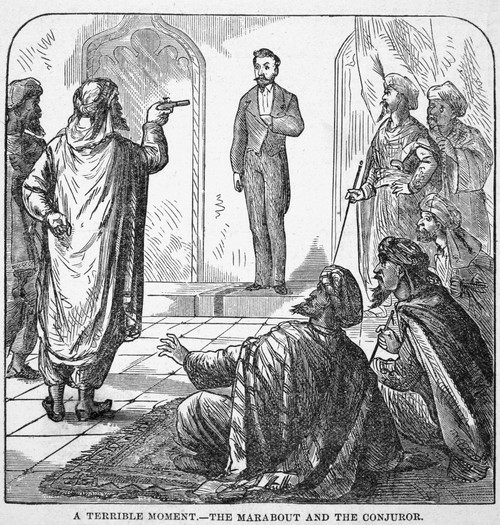
Perhaps Robert-Houdin's most extraordinary feat wasn't performed on stage at all. In 1856, France was losing control of its colony in Algeria. Local marabouts (religious leaders who claimed supernatural powers) were inciting rebellion, convincing people that French power was weak compared to their magic.
The French government asked Robert-Houdin to travel to Algeria and prove that French "magic" was superior. At 51 years old, he agreed to serve his country.
In front of tribal leaders in Algiers, Robert-Houdin performed the Light and Heavy Chest. He invited the strongest chieftain to lift it, which he did easily. Then Robert-Houdin announced he would steal the man's strength. The chest became immovable. Then Robert-Houdin added a twist: he claimed the chest would now give electric shocks. When the chieftain touched it, he received a jolt and fled in terror.
Robert-Houdin followed this with other demonstrations, including firing a marked bullet and catching it in an apple on his head, and making warriors' weapons disappear from their hands. The marabouts' influence crumbled. The rebellion dissolved. One performance had accomplished what military force couldn't. Some historians argue that Robert-Houdin's tour prevented a full-scale war and saved thousands of lives.
Cultural Impact and the Birth of Modern Magic
Robert-Houdin transformed magic from a sideshow into an art form. Before him, magicians were often viewed as suspicious figures, possibly in league with dark forces. After him, magic became respectable entertainment for the upper classes.
He wrote several influential books, including "Memoirs of Robert-Houdin" and "The Secrets of Conjuring and Magic," which became the foundational texts of modern magic. Houdini read them as a young boy and was so inspired he renamed himself "Houdini" as a tribute, adding an "i" to suggest "like Houdin."
Robert-Houdin pioneered the use of technology in magic, incorporating electromagnets, hidden mechanisms, and sophisticated lighting years before other performers. He understood that the future of magic lay in embracing new technology while maintaining the art's sense of wonder.
Influence on Performance and Character
Robert-Houdin's influence extends far beyond magic into the broader world of performance and character acting. His transformation of the magician from mystical figure to sophisticated gentleman created a template that influenced performers across generations.
Cary Grant and other leading men of classic Hollywood embodied Robert-Houdin's ideal of the elegant performer. Grant's characters often involved deception, charm, and sophistication, the exact qualities Robert-Houdin brought to magic. The suave gentleman who accomplishes impossible things through wit and style is Robert-Houdin's legacy.
Orson Welles, himself an accomplished magician, adopted Robert-Houdin's philosophy that performance was about creating complete illusions, not just executing tricks. Welles's approach to filmmaking, using every technical innovation available to create cinematic magic, mirrors Robert-Houdin's integration of technology into his art.
James Bond as a character archetype owes something to Robert-Houdin. The gentleman spy who uses sophisticated gadgets, charm, and misdirection to accomplish impossible missions is a direct descendant of the elegant magician who could prevent wars with cleverness rather than force.
Penn & Teller's modern approach, performing in suits and approaching magic with intellectual sophistication rather than mysticism, follows Robert-Houdin's revolution. They've even cited him as an influence on their decision to present magic as an art form rooted in skill rather than supernatural claims.

In "The Prestige," the character of Robert Angier, played by Hugh Jackman, embodies this tradition. He's the sophisticated showman who believes magic should be elegant, refined, and prestigious, exactly Robert-Houdin's philosophy. Meanwhile, Edward Norton in "The Illusionist" brings Robert-Houdin's actual mechanical wonders, like the Orange Tree, to life. Together, these films illustrate the two sides of Robert-Houdin's genius: the gentleman showman and the mechanical wizard.
The Legacy Lives On
Robert-Houdin died in 1871, but his influence is everywhere. Every time you see a magician in a tuxedo rather than a mystical robe, that's Robert-Houdin. Every time a magic show incorporates sophisticated technology, that's his legacy. Every time a performer focuses on presentation and elegance rather than just the trick itself, they're walking the path he created.
"The Prestige" captures his era perfectly, the time when magic transformed from crude deception into sophisticated art, when rivalry between magicians drove innovation, and when the performance mattered as much as the secret. The film's very title refers to the final part of a magic trick, terminology Robert-Houdin helped standardize.
Even today's technology companies borrow his philosophy. Steve Jobs's famous product reveals, with their emphasis on elegant presentation and the "magical" unveiling of new technology, are pure Robert-Houdin. The idea that technology should seem like magic to the user comes directly from the watchmaker who became a wizard.
Jean Eugène Robert-Houdin may not be a household name, but he created the household we all live in, where magic and technology blend, where entertainment is sophisticated, and where the impossible is presented with style. He was the most famous magician you've never heard of, the man who taught the world that true magic lies not in claiming supernatural powers, but in creating wonder through artistry, intelligence, and innovation.
Every magician since has stood on his shoulders. Even Houdini knew it, which is why he borrowed the name of the only magician greater than himself.


Comments